By Merry Outlaw and Dr. Beverly A. (Bly) Straube
The fates of many Virginians who joined Bacon’s Rebellion can be traced through surviving records. The rebellion’s eponymous leader, Nathaniel Bacon, died in October 1676 of the “Bloodie Flux and Lousey Disease,” effectively ending the momentum of his movement. In the revolt’s aftermath, Governor William Berkeley executed 23 men for treason, while a few others died before their sentences could be carried out. Most participants were eventually covered by a general amnesty, though many still faced heavy fines or property confiscation. One woman who fell outside that amnesty, Sarah Grendon, was compelled to plead that her actions were of an “ignorant woman” in order to save both her life and her estate.
Another prominent female supporter of Bacon’s Rebellion who faced retribution is Sarah Drummond. Since she was the wife of William Drummond, a prosperous planter who was hanged by Berkeley for his leadership role in the rebellion, Sarah’s property was subsequently seized. Refusing to accept her losses, Sarah successfully petitioned King Charles II for restitution in 1677. Although not specified in the historical record, archaeological evidence from her house site suggests that she was substantially compensated and able to rebuild her household.
Excavations of the Drummond plantation on the Governor’s Land adjacent to Jamestown revealed a household that was both prosperous and deeply engaged with the consumer culture of the Atlantic world. In particular, the remarkable ceramic assemblage dating primarily to the years after William’s death provides a rare opportunity to explore the social, political, and economic world of an influential colonial woman. The assemblage includes English tin-glazed earthenware, German Westerwald stoneware, North Devon slipware, locally produced coarse earthenwares, and some of the earliest English stonewares made by John Dwight at Fulham.
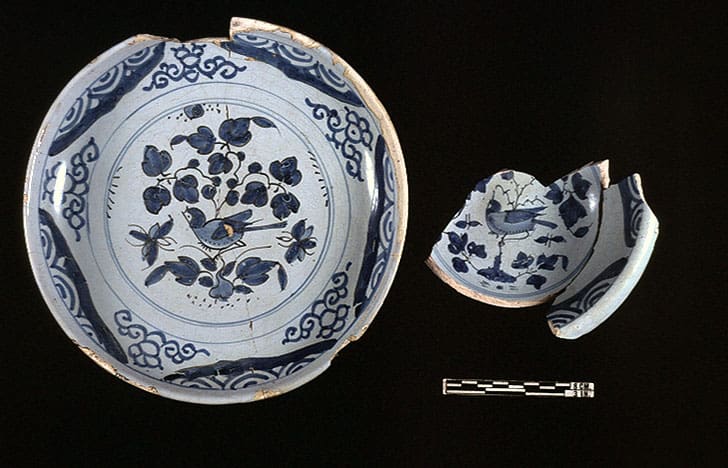
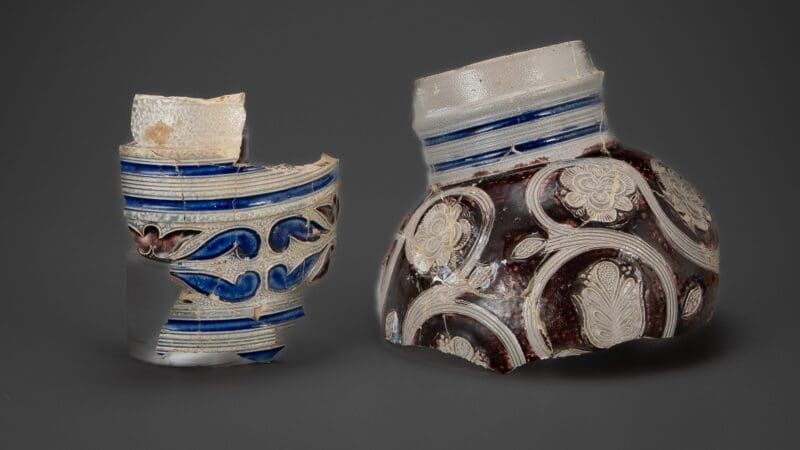
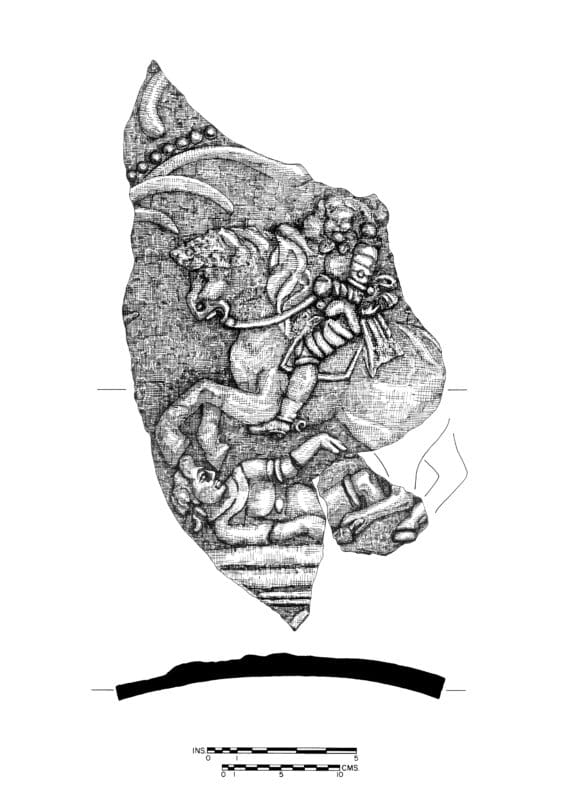
Several objects appear to have carried political significance. Among them is a tin-glazed earthenware plate rarely found in Virginia that depicts the coronation of King William III and Queen Mary II. Produced in England between 1689 and 1694, the plate was likely displayed in Sarah’s household rather than used. Its presence, along with a Westerwald jug fragment bearing the image of King William III and a cast-iron fireback depicting King Charles II triumphant over Oliver Cromwell, suggests that Sarah publicly expressed loyalty to the English monarchy. Together, these objects challenge interpretations that portray the Drummonds as anti-royalist rebels and instead support Bacon’s contention that the rebellion was directed against Governor Berkeley rather than the Crown. (will add pictures here)
The ceramic collection also sheds light on Sarah’s role as household manager. Numerous tin-glazed drinking vessels, mugs, bowls, posset pots, porringers, basins, and chamber pots demonstrate an interest in fashionable English tablewares and specialized domestic forms uncommon in Virginia. The prevalence of drinking vessels suggests participation in emerging social rituals involving punch, tea, or other beverages. At the same time, large quantities of locally produced Challis ware storage jars and milk pans indicate practical attention to everyday household needs.
Taken together, the ceramics from the Drummond site reveal a woman who actively shaped her domestic environment after the upheaval of rebellion and widowhood. Through her choices in material culture, Sarah Drummond asserted social status, political allegiance, and economic resilience. Although archaeology cannot fully recover her voice, the objects she acquired and displayed provide valuable insight into how an elite colonial woman navigated the challenges and opportunities of late seventeenth-century Virginia.
A more detailed examination by the authors of the material world of Sarah Drummond, “A Life in Sherds: the Sophisticated Ceramic World of 17th-Century Virginia Rebel Sarah Drummond,” is forthcoming in Ceramics in America 2026, Ronald W. Fuchs II (ed.).
Merry A. Outlaw
Senior Curator, Jamestown Rediscovery, Preservation Virginia
Bly Straube, PhD, FSA
Senior Curator, Jamestown Settlement, Jamestown-Yorktown Foundation
Want to learn more?
Merry Outlaw and Dr. Beverly A. (Bly) Straube are both of our five panelists we had for our event in May, “Women’s Perspectives on Bacon’s Rebellion: Expert Panel Discussion and Open House Tour” which is available on our YouTube under the Resources Tab on “Lecture Videos” or simply on our Preservation Virginia channel.


