By Brenna Geraghty, Education Manager, Preservation Virginia
After Bacon’s Rebellion in 1676, Virginia’s inhabitants were reeling. Those who had refused to side with Bacon were especially mistrustful of their neighbors, particularly those who had actively rebelled. Planters whose servants had joined the rebellion became especially paranoid.
In Westmoreland County, community tensions reached a fever pitch in 1687, when planter and Governor’s councilman Nicholas Spencer claimed to have uncovered a plot. Spencer believed that enslaved people on his plantation and in the surrounding area were planning to attack and kill English colonists. (1) Spencer provided no evidence for his claims, but his accusation panicked other planters and landholders in Virginia. Were the men, women, and children they held in bondage secretly plotting to kill them? What could be done?
The people Spencer accused were taken to trial, though no court records survive to tell us what happened. From notes taken in the Governor’s Council when Spencer first made his claims, however, the Council seemed prepared to execute the so-called conspirators. The Councillors were quick to suggest that enslavers across the colony had been too lenient by allowing enslaved people to attend funerals and visit family.
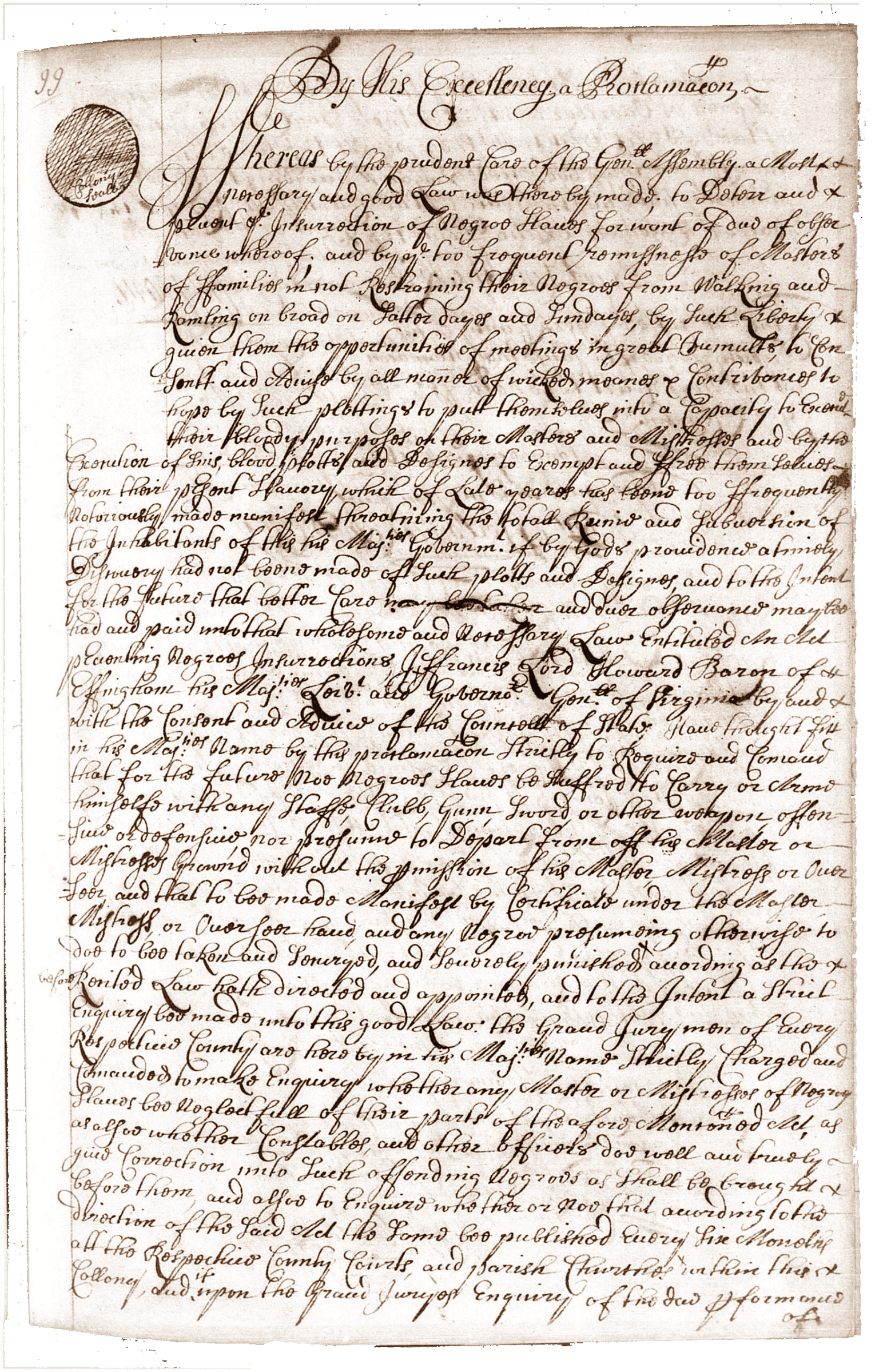
Governor Frances Howard, Lord Effingham issued a proclamation prohibiting enslaved people from traveling on the weekends and holding funerals, making the bizarre claim that funerals were just a cover-up for secret meetings used to plot against enslavers. (2) The hysteria that ensued drove a wedge between enslaved Africans and paranoid English colonists.
But was there ever really a plot? Did Nicholas Spencer invent the whole thing, or did he blow a real event out of proportion? Due to a lack of historical evidence, it’s hard to say. Whether he made it up or not, the consequences are clear. Spencer used his prominent government position to exacerbate tensions between English colonists and Africans and African-Americans. The fearmongering he caused led to the passage of several laws restricting enslaved people from owning weapons even for self-defense, leaving their site of enslavement without a pass, or gathering in large groups. Planters across the colony increasingly began to regard those they enslaved with contempt and suspicion, and even poor English colonists began to follow suit.
The 1687 Proclamation captures a pivotal moment in Virginia history when those in power chose to dramatically increase social tensions rather than resolve them, ensuring the cooperation that propelled Bacon’s Rebellion would never rise again.
Sources:
- Howard, Francis. Governor Effingham Reveals a Planned Slave Insurrection. Record of the Governor’s Council for 1687. Transcription Source: H. R. McIlwaine, ed., Executive Journals of the Council of Colonial Virginia (Richmond: The Virginia State Library, 1925), 1:86–87. Accessed via Encyclopedia Virginia: https://encyclopediavirginia.org/primary-documents/governor-effingham-reveals-a-planned-slave-insurrection-1687/
- Howard, Francis. Governor Effingham’s 1687 Proclamation, November 1687. Library of Virginia, accessed via Encyclopedia Virginia: https://encyclopediavirginia.org/683hpr-cacb0e67ee1c418/
Want to learn more on race and social class during Bacon’s Rebellion? Please click here to watch our recording of our recent lecture “Opportunities Lost: Bacon’s Rebellion and the Denial of Class and Racial Justice in the U.S.” by Dr. Blakey or find the video available on our YouTube under the Resources Tab on “Lecture Videos”.


