By Mark Summers, Education Director, Preservation Virginia
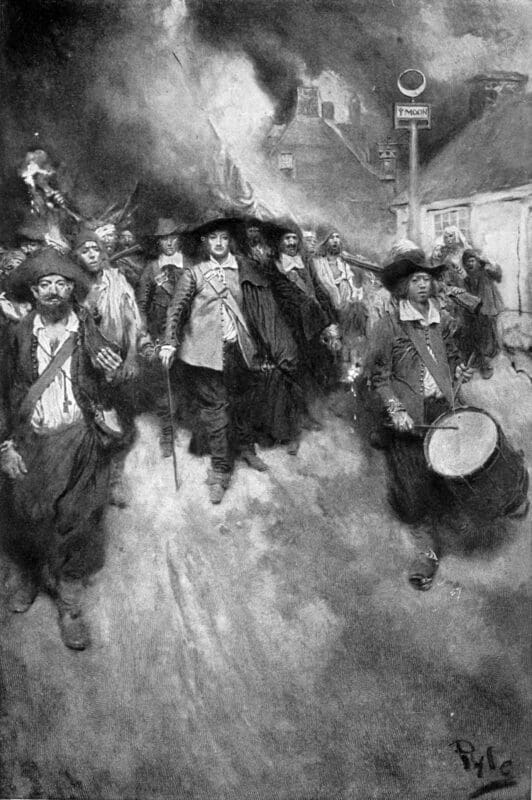
For centuries, Virginia was a spoke in the wheel of a larger English (and later British) Empire. Despite the fact that colonial Virginia was nearly 4,000 miles from England, it was heavily affected by the ebbs and flows of power in the mother country. When England was in turmoil, Virginians were affected by the chaos.
In the case of Bacon’s Rebellion, we must look to the sociopolitical events happening in England during the 1640s -1660s. This period saw the English Civil War and its aftermath, a time of political disunion, religious strife, and the dismantling and restoration of the monarchy. Both Virginia and England would draw different conclusions from this conflict.
In short, the English Civil War was not just English– it involved Ireland, Scotland, and the colonies as well. Rather than a single war, this became a series of conflicts over whether the Crown or the Parliament had ultimate authority.
It started with Charles I attempting to rule three kingdoms without Parliament, a practice known as personal rule. It accelerated when, in 1637, the king attempted to impose the Anglican Church on Presbyterian Scots. This led to a Scottish invasion and a need for the English Parliament to be called to raise funds. However, many Puritans in Parliament had more empathy for the Scots than the king. Eventually the tiny cracks in the Crown’s authority widened into chasms as both the king and Parliament raised opposing armies.
During this period, Sir William Berkeley, an aristocrat and friend to the King, became Virginia’s Governor. At first, he was a popular and open-minded leader. But as the war turned against the king, and as Parliament gained victories, Berkeley and his advisers opened Virginia as a refuge for royalist families, sometimes called “Cavaliers.” Many of these families remained prominent in the commonwealth for centuries, carrying with them a legacy of disorder and social upheaval.
Then, in 1649, the king was captured, put on trial, and beheaded. The monarchy was abolished, and aristocrats across the ocean feared for their own heads. Berkeley was removed as Governor but stayed in Virginia in “retirement” as men loyal to Oliver Cromwell ran the colony for a decade.
When the monarchy was restored in 1660, Berkeley returned to office, haunted by regicide and distrusting of many of Virginia’s “armed, poor, and discontented.” He made many decisions shockingly similar to Charles I before his own downfall. As such, when Bacon’s Rebellion arrived, it came as an aftershock of the earthquake of the English Civil War.
Biography
Mark Summers is the Education Director for Youth Public Programs at Preservation Virginia working primarily in Jamestowne. Please look forward to our September 19th event, The Burning of Jamestown at Historic Jamestowne in which will reenact the beginning of Bacon’s Rebellion as if you were there. For more information check out the specifics and ticketing information on our Events tab or click here.


